Class 11 hits differently. One month you’re finishing Class 10 board exams, feeling like you’ve got a handle on things, and the next you’re staring at a Physics numerical that seems to belong to a different subject altogether.
On top of that, seniors, teachers, and even your WhatsApp groups keep telling you this is the year you’re supposed to “start JEE.” Nobody quite explains what that means in practice, or how you’re meant to fit it in without your school exams suffering.
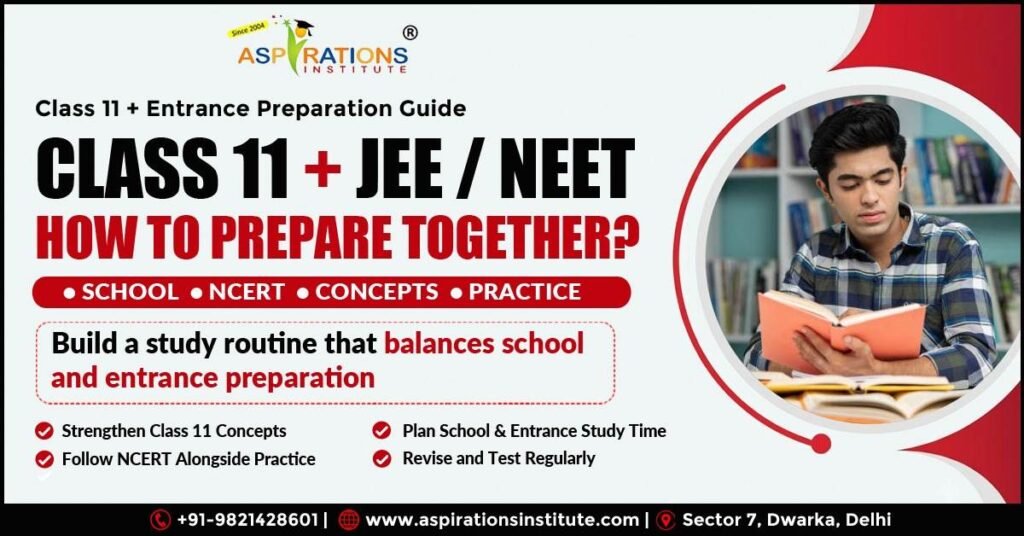
Here’s the direct answer: you can study Class 11 CBSE and build a JEE foundation at the same time, as long as your school syllabus stays the priority and JEE-style practice is added in gradually, not thrown at you all at once.
This is really what most students mean when they search for how to start JEE preparation in Class 11 — a clear starting point, not a complicated new syllabus on top of an already full one.
This guide walks through how to prepare for JEE Main from Class 11, subject by subject, using how things are genuinely taught at our centre in Dwarka Sector 7, near Ramphal Chowk — not a generic national checklist.
Quick answer: Class 11 CBSE and JEE foundation work well together when your school concepts come first, and JEE-style problem-solving is layered on top, usually through weekend sessions rather than daily overload.
Many students look up how to start JEE and NEET preparation from Class 11 as if it’s one combined plan — in reality, these are two separate journeys built on a shared Physics and Chemistry base, with NEET needing a full, separate Biology syllabus.
A structured PCM batch with subject teachers who know both the CBSE pattern and JEE basics is what makes “how early should you start JEE preparation” easy to answer: right here, right now, at a pace that suits Class 11.
Key Takeaways:
- Class 11 CBSE and JEE foundation can be studied together when school concepts stay the priority, and JEE-style practice is added gradually, not all at once.
- “How to start JEE preparation in Class 11” really means strengthening Physics, Chemistry and Maths — it does not include NEET Biology coaching, which would need separate, dedicated preparation.
- A combined batch (rather than two separate coachings) keeps pacing consistent, since the same teacher builds both your CBSE concepts and your JEE-style practice.
- Batch sizes stay small — 15 to 18 generally, capped at 15 for Chemistry and Maths — so weak chapters don’t go unnoticed.
- Extra chapter-wise practice and a free demo class are both available if you want to test the approach before committing.
Why Class 11 Suddenly Feels Like a Different Subject
The honest reason Class 11 feels harder isn’t that you’ve suddenly become weaker at studying. The syllabus genuinely jumps in depth.
- Physics moves from straightforward numericals to multi-step problems that need you to pick the right formula before you even start calculating.
- Chemistry splits into three separate branches — Physical, Organic and Inorganic — each with its own way of thinking.
- Maths starts demanding speed as much as accuracy.
None of this means you’re behind. It means Class 11 is the first year built around real concept clarity rather than memorised steps, and that takes a slightly different study rhythm than Class 10 did — which is exactly why building a strong foundation for JEE in Class 11 works better when it’s paced alongside your school learning, not squeezed in separately.
What "JEE Foundation" in Class 11 Actually Means (and What It Doesn't)
Building a JEE foundation in Class 11 means strengthening your Physics, Chemistry and Maths concepts to a level where JEE-style questions stop feeling unfamiliar — while your CBSE syllabus stays the main focus.
At our centre, this happens through the regular Class 11 PCM classes taught by Gagan Sir for Physics, Shahbaz Sir for Chemistry and Narender Sir for Maths, with JEE-style exposure layered in through weekend sessions.
This is really the practical answer to how to start JEE preparation as a guide for Class 11 students — not a separate course, but a natural extension of what you’re already studying.
It does not mean a separate NEET programme. If you’ve searched for something like how to start NEET preparation from Class 11 or how to prepare for NEET from Class 11 alongside your JEE questions, it’s worth knowing upfront that NEET preparation involves a full Biology syllabus, which isn’t something covered in this Class 11 PCM structure.
Your strong Physics and Chemistry basics from this course will still help later if you do pursue NEET — but that would need its own, dedicated Biology preparation, separate from this batch.
Knowing this upfront saves you from the common mistake of assuming “JEE/NEET foundation” is one single package. It’s worth being clear about what you’re actually signing up for before you plan your year around it.
Not sure which fits?
Our faculty help students work through this decision individually before subjects are finalised.
Coaching-Only, Self-Study, or a Combined CBSE + JEE Approach — What Actually Works
Most Class 11 students weigh three options, and each has a real trade-off.
Self-study alone works only if you’re already disciplined and know how to identify your own weak chapters. Without a teacher checking your Physics numericals or your Chemistry equations regularly, small errors tend to repeat for months before you notice.
A separate JEE coaching alongside regular tuition can work, but it often means two different teaching styles for the same topic, extra travel, and sometimes JEE material that races ahead of what you’ve actually covered in school that week.
A combined CBSE + JEE-exposure batch solves the pacing problem, because the same teacher who’s building your school concepts is the one introducing JEE-style questions once those concepts are solid — not before.
Our Class 11 PCM batches run at a standard size of 15 to 18 students, with the Chemistry and Maths batches specifically capped at a maximum of 15, so weekly worksheets and doubt-clearing don’t get lost in a crowd.
If you’re trying to work out how early you should start JEE preparation, this combined structure gives you the answer without overthinking it — concepts first, competitive practice layered in as they get stronger.
Building Your Foundation Subject by Subject
Physics — From Concepts to JEE-Style Problem-Solving
Physics in Class 11 is where formula selection starts to matter as much as the formula itself. This is really where how to prepare for Physics for JEE begins in practice — not with shortcuts, but with the basics done properly.
Gagan Sir, who has been teaching Physics for over 10 years, builds this step by step, starting with the “why” behind a concept before moving into the kind of multi-step numericals and derivations that JEE questions are built on. You can read more about how this is structured on our Class 11 Physics tuition page.
Chemistry — Physical, Organic and Inorganic, Built Step by Step
Chemistry can feel scattered at first because it’s really three subjects wearing one name. if you’ve read guides on how to prepare for Physics and Chemistry for JEE and NEET, you’ll notice Chemistry is usually described as the “common ground” subject — and that’s true here too.
Shahbaz Sir, with around 7 to 8 years of teaching experience, explains Physical, Organic and Inorganic Chemistry with bilingual explanation where needed, backed by NCERT-based practice so the basics stay solid even as JEE-style questions get introduced. Details on the full course are on the Class 11 Chemistry tuition page.
Maths — Speed and Problem-Solving for CBSE and Competitive Papers
Maths in Class 11 rewards speed as much as understanding. Narender Sir, who brings over 16 years of experience, uses regular NCERT exercises and weekly worksheets to build accuracy first, then gradually introduces the faster, competitive-style problem-solving that both CBSE and how to prepare for IIT JEE from Class 11 eventually demand. More on how this works is on our Class 11 Maths tuition page.
Weekend JEE Exposure for Students Near Ramphal Chowk, Sector 7
If your daily Class 11 classes are already handling your CBSE syllabus, weekend sessions are where JEE-style exposure fits in without eating into your weekday routine.
These sessions are usually introduced later in the academic year, once your core Physics, Chemistry and Maths concepts for the term are in place — it’s best to confirm the current timing directly with us rather than assume a fixed month.
Our centre, Aspirations Institute, is located at B-185, Palam Extension, Near Ramphal Chowk, Sector 7, Dwarka, which makes it a manageable stop for students already commuting for school or other classes nearby.
If you’re looking at how to start JEE Main preparation from Class 11 in a way that stays connected to your neighbourhood routine, this weekend structure is built around exactly that.
You can see how it connects with broader JEE preparation on our JEE Main coaching in Dwarka page.
Where Extra Chapter-Wise Practice Fits in
Attending class is one thing — knowing whether you’ve actually understood a chapter is another. For extra practice outside class hours, our Class 11 chapter-wise practice tests on the MCQ Tests portal let you attempt Physics, Chemistry and Maths questions by chapter, with instant results so you can see where you stand before your next class.
This kind of practice is meant to support what you’re already learning, not replace it. It’s especially useful in the days before a school test, when you want to check a specific chapter rather than revise everything at once.
Should You Start JEE Prep in Class 11, or Wait Until Class 12?
Starting some JEE-style exposure in Class 11 is generally the more comfortable option, simply because a large share of the JEE syllabus overlaps with your Class 11 concepts. Waiting until Class 12 means learning new Class 12 topics and revisiting Class 11 basics for JEE at the same time, which is a heavier load in a year that already has board exams.
This is usually the real answer behind “how early should you start IIT JEE and NEET prep” style questions — earlier is easier, but only when it’s paced properly. “Starting early” doesn’t mean rushing ahead of your school syllabus. The more realistic version is what’s outlined above — solid Class 11 concepts first, JEE-style practice layered in through weekend exposure once those concepts are steady.
Start Class 11 With a Clear Plan, Not Just Good Intentions
Class 11 doesn’t need to feel like a tug-of-war between school exams and JEE preparation. When your core PCM concepts are built properly first, and JEE-style practice is added at the right pace, both goals support each other instead of competing.
If you’d like to see how this actually looks in a classroom, you’re welcome to explore our full Class 11 Science tuition course, sit in on a demo class before deciding anything, or simply call us at +91-9821428601 to ask your specific questions.
Frequently Asked Questions
It’s possible in theory, but it means covering a full Biology syllabus alongside Physics, Chemistry and Maths, which is a significantly heavier load than JEE preparation alone. Most students searching for how to start JEE and NEET preparation from Class 11 find it more manageable to build a strong PCM foundation first and treat NEET as a separate decision with its own dedicated Biology preparation.
Our Class 11 Science coaching covers Physics, Chemistry and Maths, with weekend JEE-style exposure layered in. We don’t currently run a separate NEET or Biology programme. Strong Physics and Chemistry basics from this course will still be useful if you pursue NEET later, but that would need additional, dedicated Biology preparation elsewhere.
Not when it’s structured properly. JEE-style exposure is introduced through weekend sessions after your regular Class 11 classes have covered the core concept, so your CBSE syllabus stays on schedule. The goal is to reinforce what you’ve learned, not to run ahead of it.
Our standard Class 11 batch size is 15 to 18 students. For Chemistry and Maths specifically, batches are capped at a maximum of 15, which helps each teacher keep track of individual doubts and weak chapters through the year.
Our Class 11 Science batch already includes weekend JEE-style exposure alongside your regular CBSE classes, so a separate JEE coaching isn’t necessary if you’re aiming for this combined approach. The same subject teachers handle both, which keeps the pacing consistent.
Yes. Our Class 11 chapter-wise practice tests on the MCQ Tests portal let you attempt Physics, Chemistry and Maths questions chapter by chapter, with instant results so you can spot weak areas between classes.
Yes, a free demo class is available before you enrol, so you can sit in on an actual Physics, Chemistry or Maths session and see the teaching style firsthand. It’s a good way to decide before committing to a batch.